


Developmental Biology at the Bench

Download 2024-2025 provisional planning
Master in Life Sciences, ENS
UNBIO1-053 (S16) | Developmental Biology at the Bench
Year and Semester : M1 | S1
Duration : 6 days | 35 hours | from 13th December 2024 to 20th December 2024
Hours : No courses are planned for Thursday afternoon
Maximum class size : 9 students
Coordination
Iris Salecker, PU, Département de Biologie, ENS (responsable du module)
Credits
3 ECTS
Hours
9 am – 6 pm (with breaks) : 9h lectures (including journal clubs and discussions) and 26h practical work.
Keywords
Developmental biology | Model organisms : chick, Drosophila melanogaster, C. elegans | Neural stem cells | Cell fate specification | Axonal wiring | Brainbow technologies | Mosaic analysis | Electroporation | Spinning disc and confocal microscopy
Course prerequisites
There will be no specific requirements to attend this module. However, participants should bring plenty of curiosity and an inquisitive mind. Some background in cell, molecular and developmental biology, as well as neurobiology and genetics would be recommended.
Course objectives and description
Aims : This module will enable participants to gain practical experience in a set of basic and advanced technologies underpinning Developmental Biology and in particular Developmental Neurobiology research as one topic in the wider field.
Themes : The brain is an astonishingly complex organ in the body of animals. It consists of a large diversity of neuron and glial subtypes, each endowed with distinct morphologies and functions within interconnected neural networks.
Understanding, how a nervous system is assembled step by step during development is a fascinating challenge.
Recent years taught us that the integration of findings obtained through studies in different animal species –each offering distinct advantages and experimental possibilities– is instrumental for uncovering fundamental developmental principles. Our course seeks to bring across this notion by introducing students to three model organisms, the nematode Caenorhabditis elegans, the fruit fly Drosophila melanogaster and the chick Gallus gallus.
Lectures and practical workshops will center around three questions :
(1) how do neural stem cells switch between proliferation and differentiation,
(2) how is the fate of neurons specified, and (3) and how do neurons wire together ?
The students will gain hands-on experience in different experimental genetic strategies used by « worm, fly and chick people » to tackle these questions.
A focus will be on the visualization of above specific developmental steps in conjunction with high end light microscopy (including electroporation and live imaging) and the exploration of underlying molecular mechanisms through targeted manipulation of candidate gene function.
Organisation : The module will include a set of 6 lectures that introduce the conceptual and technical background of planned experiments and the three model organisms.
These will complement the ateliers where the students learn hands-on how to work with worms, flies and chick embryos at different developmental stages, to prepare samples following genetic manipulations, as well as to acquire and interpret images obtained through microscopy.
Assessment
Grades will be based on course presence and punctuality (10%), course practical/seminar participation (30%), and 30’ group presentations and discussions of TP projects (60%).
Course material
Pdf versions of Powerpoint presentations and reading material for the workshops will be provided online via Moodle.
Suggested readings in relation with the module content
• Primary literature and review articles related to presented topics will be provided via Moodle.
• Some chapters in relevant textbooks (Michael Barresi and Scott Gilbert : Developmental Biology ; Lewis Wolpert, Cheryll Tickle, Alfonso Martinez Arias : Principles of Development)
• Key papers about course topics will be provided before the start of the module via Moodle.
Teaching Team
Marie Gendrel, MCF, Département de Biologie, ENS
Xavier Morin, DR CNRS, Département de Biologie, ENS
Iris Salecker, PU, Département de Biologie, ENS
Previous course impressions
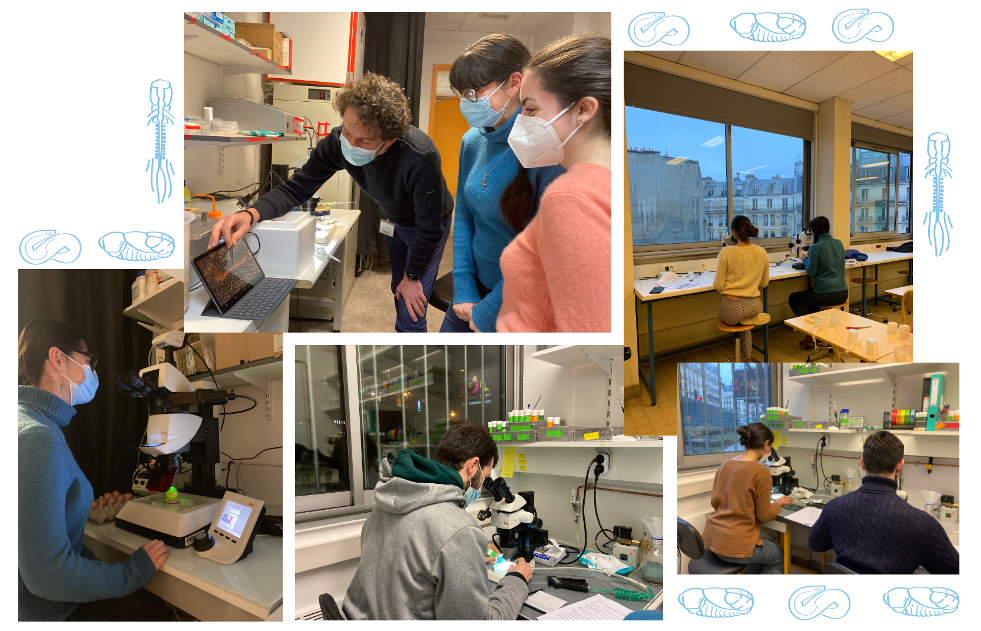
Fascinated by Developmental Biology ? This practical course introduces our students to experimental work with three major models : C. elegans, Drosophila and the chick embryo.
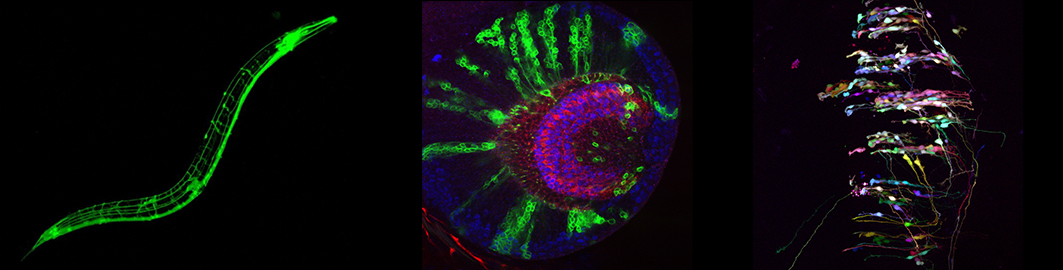
Left : CNS C. elegans (image J.L. Bessereau lab)
Middle : Larval optic lobe Drosophila melanogaster (image I. Salecker lab)
Right : Chickbow labeled CNS Gallus gallus (image X. Morin lab)