


Courses and internship
Master 2 IMaLiS
- Beginning of the academic year
- Planning, Tracks, Courses 2024-2025
- Other courses at ENS-PSL
- Other courses at PSL and partner institutes
- Internship
Beginning of the academic year
The academic year will begin at the begining of september 2025 (date to come).
Planning, Tracks, Courses 2025-2026
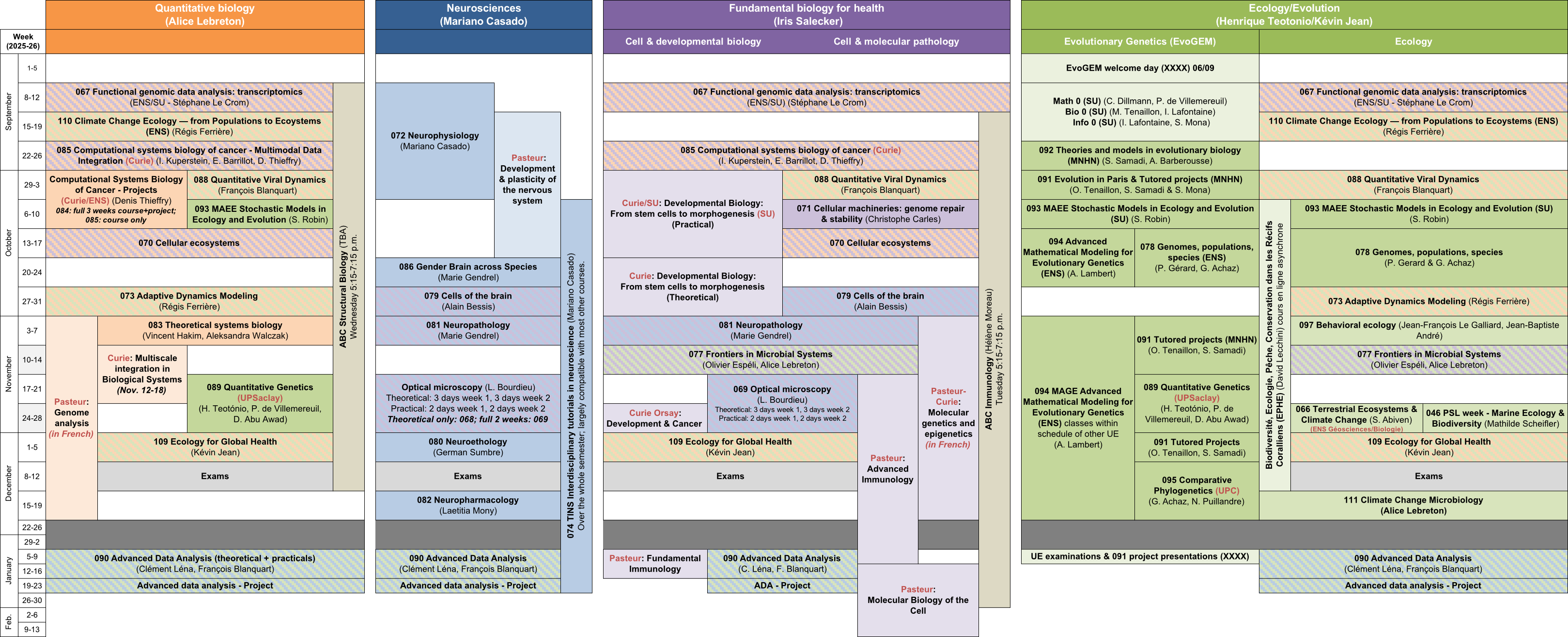
Detailed plannings are available for each track below :
- Quantitative biology Coordinator : Alice LEBRETON
- Neurosciences Coordinator : Mariano CASADO
- Ecology and evolution Coordinator : Henrique TEOTONIO, Kevin JEAN
- Fundamental biology for health Coordinators : Iris SALECKER
The first semester (30 ECTS) is mainly devoted to courses following one of the tracks. Sub-tracks are proposed for further specialization. Cross-sampling between tracks is still possible, provided faculty are in agreement.
In all cases, students will have to validate their study program with their track coordinator before the beginning of the year.
Other courses at ENS-PSL
Students can combine courses from the tracks with other selected courses from ENS-PSL.
2025-2026 Graduate Program in Life Sciences courses
2025-2026 Qlife Winter and Spring schools
2024-2025 Graduate Program in Life Sciences courses
- Initiation to python programming
- Machine Learning in Python with scikit-learn
- Advanced Biology Course on Rare diseases - ABC-R [cancelled]
2024-2025 Qlife Winter and Spring schools
Other courses at PSL and partner institutes
See list of other PSL courses and partner institutes.
Internship
The second semester is spent completing a 5-month internship with an academic or industry research group, in France or exceptionally abroad.
According to the courses chosen by the student, it can start between the beginning of November and the beginning of February at the latest but it cannot be shorter than 20 weeks. This internship can be considered as a prelude to a PhD thesis.
Choice of the laboratory
The host lab is chosen together with the teaching staff.
Enrolled students will have access to a list of proposed internships. This include internships from partner laboratories (PSL laboratories) and from other historical partners, i.e. Sorbonne Université, Université Paris Cité, or others high level French research institutions. All internships have to be validated by the teaching team.
Student recipient of the Qlife scholarship have to chose their internship laboratory among Qlife laboratories :
Qlife laboratories
Evaluation of the laboratory training
To validate their internship, students submit a written report and defend their results in front of a jury at the end of June.